



[an error occurred while processing this directive]
  • Products
  • Insights
  • Practice Management
  • Resources
  • About Us
[an error occurred while processing this directive]

International equities have begun to assert their dominance, in stark contrast to the US equity dominance that had been in place for the past decade. But is this a short-term shift in performance leadership, and merely a temporary response to current conditions? In my view, these five potential drivers could lead to persistently strong performance for international equities. 

1. AI Reset: Markets were surprised last year when several Chinese firms claimed to have made breakthroughs in their AI capabilities. Up to that point, the consensus was that delivering competitive generative-AI solutions required access to cutting-edge chips and substantial electrical power. 

China’s Deepseek, and later Alibaba and Tencent, claimed they were able to produce competitive generative-AI systems despite having limited access to state-of-the-art semiconductors due to sanctions. Their solutions also required a small fraction of the power needed by their Western counterparts. 

Additionally, we’ve seen a broadening out of AI chip design beyond Nvidia, though actual chip production continues to rely on offshore manufacturing and foundry hardware. In combination, these changes could ultimately lead to investors rethinking their outlook for big US tech players in the AI space, as well as firms down the AI value chain (such as data-center builders, wiring providers, and electric utilities, among others). The winners could expand beyond the handful of domestic companies to include many international players (FIGURE 1).
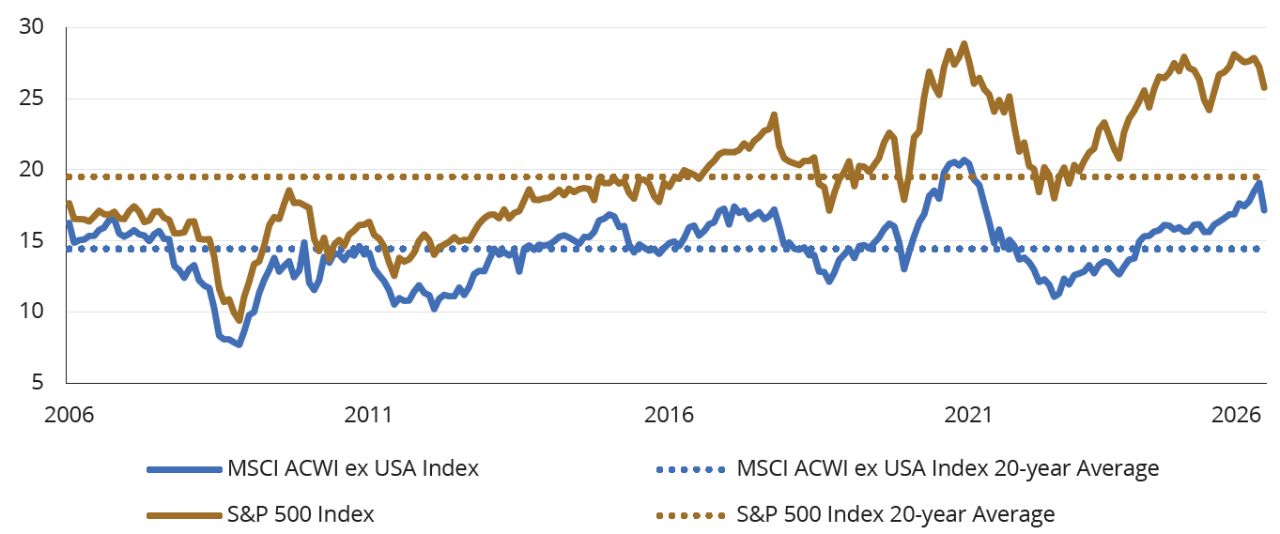

FIGURE 1

Major International Companies Driving AI Innovation

Company  Ticker  Country  AI Focus
Taiwan Semiconductor   TSM  Taiwan Manufactures advanced AI chips used by NVIDIA, Apple, and others
ASML   ASML  Netherlands  Supplies extreme ultraviolet lithography machines essential for AI-chip production
Samsung Electronics SSNLF South Korea Develops AI for mobile devices, semiconductors, and smart appliances
SoftBank Group Corp. SFTBY Japan Major investor in AI startups and owns Arm Holdings, a key chip-architecture firm
Baidu, Inc.  BIDU  China  Operates large-language models, autonomous driving, and AI cloud services
Alibaba Group Holding Ltd.  BABA China  AI in e-commerce, logistics, and cloud computing (Alibaba Cloud AI services)
Tencent Holdings Ltd.  TCEHY  China  AI in gaming, social media, and healthcare; operates its own AI lab
NEC Corporation  NIPNF  Japan  AI in public safety, biometrics, and enterprise solutions
Hitachi, Ltd. HTHIY  Japan  AI in industrial automation, energy systems, and smart infrastructure


2. Changes in Fiscal Spending:
The US employed expansionary fiscal policy after COVID-19, including roughly $1 trillion in funding from the Inflation Reduction Act. Outside the US, meanwhile, austerity was the prevailing policy during the same time frame. However, we’ve begun to see a reversal of that trend. 

In the US, the pace of new fiscal stimulus has moderated. Couple that with last year's roll-out of the Department of Government Efficiency and its heavy, targeted cuts to spending, and the fiscal outlook for the US is projected to be contractionary relative to recent levels.

By contrast, the fiscal spending outlook elsewhere looks to be on the upswing: High-profile estimates for spending pledges on infrastructure and defense are in the $1.5 trillion range in Europe. The bulk of this proposed spending came from Germany as part of significant changes to the debt-spending philosophy of the world’s third-largest economy, but there's also prospective fiscal stimulus on the horizon in Japan.

3. Continued Trade Tensions: Given the emphasis on tariffs during President Donald Trump’s campaign, their Liberation Day roll-out shouldn’t have been much of a surprise. Nevertheless, the sudden and unclear implementation caught markets off guard, and now the continued uncertainty over trade policy has only continued as the Trump administration finds alternative ways to implement tariffs and trade partners respond with retaliatory tariffs of their own.

Domestic producers might find it harder to manage the impact of tariffs if they rely on foreign-sourced components.  


While companies worldwide have developed global supply chains over decades, foreign firms have the potential to shift their output to destinations outside the US to avoid some of the tariff impacts. Domestic producers, however, may be finding it harder to manage the impact of shifting tariffs if they rely on foreign-sourced components to any extent. Both imported Personal Consumption Expenditures1 core goods and durable goods prices rose by 1.5% through January 2026, showing that domestic producers may have eaten some costs, but have also begun to pass the costs on to consumers, who may have either stopped buying certain products together or begun purchasing more affordable alternatives.

4. Increased Focus on Shareholder Returns: As a means of encouraging both domestic and foreign investment in Japanese equities, the Tokyo Stock Exchange instituted reforms in 2023 aimed at improving corporate governance. These reforms encouraged firms to focus on improving their price-to-book2 ratios (which for many companies on the exchange were below 1.0), as well as an increased emphasis on improving shareholder returns. These reforms have had a positive impact thus far, not only in terms of increased share buybacks and dividends, but also through rising share prices. 

On the heels of this program’s success in Japan, exchange operators in South Korea enacted a similar program in 2024, while further reforms were announced in early 2025. Korean equities have already begun to benefit from the implementation of these programs, though it is still early days and there's still potential for adoption to spread.

5. Valuation Gaps: Pundits have been using valuation gaps to justify "why international" for years. And while their assertion was correct—valuation gaps were at noteworthy levels relative to history—the unfortunate reality is that it is fairly common for international equities to trade at a discount vs. their US peers (FIGURE 2). 


FIGURE 2

The Valuation Gap Between US and International Equities Is Near its Widest
Trailing 12-month Price/Earnings for MSCI ACWI ex USA Index vs. S&P 500 Index

Mountain chart

As of 3/31/26. The price-to-earnings ratio measures a company’s share price relative to its earnings-per-share and helps assess the relative value of a company’s stock. Indices are unmanaged and not available for direct investment. Please see page 4 for index definitions. Data Source: Morningstar, 4/26. 


Though we don’t necessarily see this valuation gap alone as a catalyst for international equities to outperform, its breadth leaves plenty of room for international-equity valuations to become richer while still remaining cheap relative to US markets. 

Even with their recent performance advantage, international markets continue to be attractively valued relative to US equities. Through March 31, 2026, the MSCI ACWI ex USA Index was trading at a roughly 33% discount to the S&P 500 Index. 

These five trends might just be the catalysts we’ve been waiting for to spur outperformance from international equities.  


The Bottom Line 

For years, we’ve been reminded of the diversification* benefits brought by allocating to international equities, with hopes that mean reversion could drive returns due to cheap valuations. What we’ve seen is that those low valuations have been a prerequisite, but weren’t enough to generate competitive relative returns alone. However, these five trends might just be the catalysts we’ve been waiting for to spur outperformance from international equities. 


Talk to your financial professional about your portfolio’s exposure to international stocks. 

Diversification does not ensure a profit or protect against a loss in declining market.

PCE (Personal Consumption Expenditures) measures the price changes for a wide range of goods and services purchased by consumers, including durable goods (e.g., cars), non-durable goods (e.g., food), and services (e.g., healthcare). The Federal Reserve uses the PCE price index to measure inflation because it adapts quickly to changes in consumer spending patterns and covers a broad range of expenses. 

2 Price/book is the ratio of a stock's price to its book value per share.

MSCI ACWI ex USA Index is a free float-adjusted market-capitalization index that measures the performance of both developed and emerging stock markets, excluding the United States.
S&P 500 Index is a market capitalization-weighted price index composed of 500 widely held common stocks. 

Important Risks: Investing involves risk, including the possible loss of principal. •  Foreign investments may be more volatile and less liquid than US investments and are subject to the risk of currency fluctuations and adverse political, economic, and regulatory developments. These risks may be greater, and include additional risks, for investments in emerging markets or if a fund focuses in a particular geographic region or country. 

Hartford Funds may or may not be invested in the companies referenced herein; however, no particular endorsement of any product or service is being made.

The views expressed here are those of the author. They should not be construed as investment advice. They are based on available information and are subject to change without notice. 

This material and/or its contents are current as of the time of writing.


WP841 5419753

Insight from Hartford Funds
Author Headshot
Investment Specialist, International Equity
[an error occurred while processing this directive]
[an error occurred while processing this directive]